Entries in Cuisines: Steakhouse (49)

Porter House Evolves

porterhouse_inside.jpg

I dropped in at Porter House New York last night for a quick bite. On a Thursday evening at around 6:30 p.m., the restaurant was mostly empty. Many servers and runners were just standing around. As in the past, the clientele included a number of families with small children.

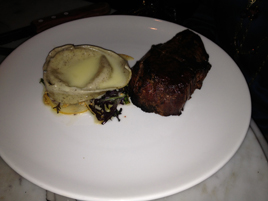
I wasn’t that hungry, so I had the Skirt Steak, at $28 the second-cheapest entrée (after the chicken, $27). This is a second-string cut of meat, but Porter House gives it a first-rate preparation, with a nice smokey char and an Argentine chimichurri sauce.

porterhouse_outside.jpgSince my last visit, Porter House has wisely dropped its plats du jour—dishes that are served only one night of the week. The Cowboy Steak, formerly available only on Thursdays, is now offered every day. On a less happy note, that steak was $38 fifteen months ago; it is now $45.

The “porterhouse” conceit has been scaled back. There were once porterhouses not just of beef, but also lamb, veal, pork, and even monkfish; only the beef and the veal options remain. There were once more than half-a-dozen seafood entrées; there are now only four.

There are, of course, other entrées: hangar steak, filet mignon, chili-rubbed ribeye (not worthwhile at $48), lamb chops. But with a few exceptions (“Duck Steak”), the restaurant is evolving closer to the classic steakhouse, albeit with one of the world’s best views.

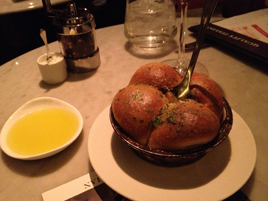
Bread service remains a strength, with three excellent house-made breads and a soft serving of butter. I didn’t order wine, but the wine list didn’t seem quite as egregiously priced as it was last time. Aside from that, I had a somewhat dour server who seemed displeased with his lot in life. Come to think of it, nobody seemed especially pleased. An empty restaurant will do that.

In a sense, Porter House is a somewhat less interesting restaurant than it was before. But the steaks remain top-notch, and the ambiance is more comfortable than most steakhouses.

Porter House New York (Time-Warner Center, 10 Columbus Circle, 4th floor)

Food: *½
Service: *½
Ambiance: **½
Overall: *½

Bern's Steakhouse

berns_outside.jpg berns_inside.jpg

The words “fine dining” and “Tampa, Florida” seldom occur in the same sentence. For a recent family celebration, only one restaurant came to mind: Bern’s Steakhouse. It is the one Tampa restaurant with an international reputation, founded largely on its 700,000-bottle wine cellar, believed to be the largest privately-held wine collection in the world.

That collection is so large that about 80% of it is not even stored at the restaurant, but in a warehouse across the street. The 212-page novel-length wine list is a massive tome, including bottles hundreds of years old. The list of wines available by the glass (around 150) is more than most restaurants offer by the bottle.

berns_logo.jpgThe restaurant, named for Bern Laxer, has been at this site since 1956. Laxer’s son, David, is now in charge.

The building, not originally a restaurant, is unimpressive from the outside. But once you get in, the rest of Bern’s is as overwhelming as its wine list. Its eight dining rooms, each with a different theme, seat up to 350. Our party of eight was in a room featuring enormous photographic mural of the Rhone valley.

Bern’s doesn’t do anything small. The menu goes on for eighteen pages, several of which are long essays explaining how—in the restaurant’s favorite phrase—“We do things differently here.” Want to start with caviar? There are twenty-one selections, priced from $20–220 per ounce. Want steak tartare? Bern’s offers it four different ways.

The steak portion of the menu goes on for four pages, because Bern’s can do nothing without lecturing you. There are fifty-one ordering options—a function of the cut of meat and the desired thickness—priced anywhere from $29.10 for a six-ounce filet mignon, to $233.12 a sixty-ounce strip sirloin that feeds six. You’d think they could round the cents on a $233 steak.

Bern’s serves USDA prime beef, aged 5–8 weeks. They are aggressive about trimming fat and bone before cooking, so their eight-ounce steak has more edible content than it would at other steakhouses. The menu claims that they buy about 3–4 pounds of beef for every pound they serve.

Most of the steaks are around $35–40 per person, but Bern’s doesn’t follow the typical steakhouse à la carte model. Every entrée also includes French onion soup, a house salad, a baked potato, onion rings, and vegetables. Dinner for six adults and two children was $419 before tax and tip, and that figure included the wine—more on that below—and cocktails. The same dinner in New York would cost at least double that.

berns_sommelier1.jpg berns_sommelier2.jpg berns_sommelier3.jpg

As I studied the wine list, I could hardly contain myself as I saw one bargain after another. I settled on a magnum of 1967 Julien Devèze Châteauneuf-du-Pape, which was around $140. The sommelier tried to upsell me to a bottle that was $100 more, but after I declined, he brought back the 1971, which he insisted was better, and at $126 was less expensive than the bottle I’d asked for.

To put that in perspective, at the New York wine-themed restaurant Veritas, the cheapest magnum of Châteauneuf-du-Pape costs $175, and it’s a 1999, twenty-eight years younger than the one we had. Veritas has only a handful of choices older than 1990, and only one older than 1980, whereas Bern’s has a long list of bottles going back to at least the 1960s.

The wine was superb, though I don’t have much to compare it to. In New York, a bottle that old, if you could find it, would cost the equivalent of a monthly mortgage payment.

berns01a.jpg berns01b.jpg

Everyone loved the French onion soup (above left), but a plate of “cheese toast” (above right)—basically melted cheese on saltine crackers—wasn’t much good at all.

berns02a.jpg berns02b.jpg

The house salad (above left) was just fine, while my son ordered the caesar salad (above right) for $9.95 extra, which our waiter prepared tableside, in a multi-step process that seemed to take fifteen minutes.

berns03.jpg

My girlfriend and I shared the 16 oz. Delmonico ($69.34), which the restaurant recommends as a portion for two. It doesn’t look that big, but we filled up quickly, given all of the other food included. The steak itself was just about perfect, with a nice exterior char, marbling, and the nutty, tangy flavor that comes from long aging.

Vegetables were a mixed bag. The onion rings were stringy and greasy, and the other vegetables on the plate were rather dull, but the baked potato was wonderful. Most restaurants would leave it to each guest to apply the fixin’s, but our waiter split each potato at tableside and applied sour cream, bacon, and chives according to each diner’s preference.

Service in the main dining room was excellent. All of Bern’s waiters train for a full year before they’re permitted to serve customers on their own. Garnishes and sauces are all applied tableside, and the waiter himself serves and clears every dish.

berns_kitchen.jpg berns_winecellar.jpg

Be sure to ask for a kitchen and wine cellar tour, normally given between dinner and dessert. It takes about fifteen minutes, and is well worth it.

Dessert is such an unusual experience that you should order something even if you’re not hungry. It’s served upstairs in the Harry Waugh Dessert Room (named for a famous wine collector). It’s actually not a room, but a rabbit’s warren of many rooms: to be exact, forty-eight separate alcoves of varying sizes, each shaped like a wine cask, that can accommodate between two and twelve guests.

No one will be surprised that dessert here, like everything else, is over the top. The menu is four pages long, and has about 60 selections. It comes with yet another wine list, this one 42 pages long, with another 1,800 selections (armagnacs, cognacs, scotches, brandies, ports, etc.)

berns04a.jpg berns04b.jpg
Left: Dulce de Leche Liquid Center Cake ($10.95); Right: Tiramisu ($9.95)

berns05a.jpg berns05b.jpg
Left: Chocolate-Chocolate-Chocolate ($10.95); Right: Macadamia Nut Sundae ($10.00)

We were mildly disappointed with a Macadamia Nut Sundae, if only because its billing on the menu (“best sundae in the world”) would have been tough for any dessert to live up to. I don’t think anyone finished their desserts (how could they?) but there were vague nods of satisfaction around the table.

Service in the dessert room was nowhere near as polished as in the main dining room. The waiter’s recommendations weren’t quite as good as they were cracked up to be, and on two occasions it took a major hunting expedition to find him.

The overall dessert room bill, including drinks, was $75.60 before tax and tip.

*

After you get past the steaks, there is some unevenness at Bern’s. Any restaurant with such a long menu is bound to have some soft spots. But the overall experience is incomparable, and the wine list ranks with the great pyramids as one of the wonders of the world.

Bern’s Steakhouse (1208 South Howard Avenue, Tampa, Florida)

Food: ***
Wine & Spirits: ****
Service: ***
Ambiance: ***
Overall: ***

Posted on Monday, May 12, 2008 at 04:41PM by Registered CommenterMarc Shepherd in , , | CommentsPost a Comment | EmailEmail | PrintPrint

Uncle Jack's Steakhouse

unclejacks_outside1.jpg

New York’s bustling steakhouse industry has settled into three distinct camps: classic, modern, and Peter Luger clones.

Classic steakhouses feature fairly predictable menus, old-school waiters (always men), and throwback décor (mahogany paneling, white tablecloths, oil paintings). You often see large, boistrous, all-male parties at these places; they’re much favored by investment bankers celebrating the latest deal, and so forth. Sparks and Keens are typical classic steakhouses.

unclejacks_outside2.jpgModern steakhouses are those that break the mold, usually by offering non-steak items you can take seriously, more inventive side dishes, friendlier service, and more contemporary décor. BLT Prime and Craftsteak head up this category.

The Luger clones are a variant on the classic steakhouse, but there are enough of them to list separately. The key giveaway is a menu that emphasizes “Steak for One” (Two, Three, or Four), the famous thick-cut Canadian bacon, and German-fried potatoes as a side dishe. Examples include Wolfgang’s and Mark Joseph.

Uncle Jack’s Steakhouse is firmly in the classic mold, and it may be the best of the bunch. I loved my first visit there, 2½ years ago, even if my three-star rating was utterly crazy. I don’t know what took me so long to get back, as the Ninth Avenue location is practically on the way home. Anyhow, I finally got back again the other night.

unclejacks01.jpg

I was enormously impressed with a truncheon-sized ribeye ($45) with a beautiful exterior char. Only at Strip House have I seen it bettered.

I was impressed with the wine list, too: a hefty tome with plenty of decent bottles below the $50 mark, and wines by the glass that are actually printed. At most of the classic and Luger-style steakhouses, the waiter just intones, “Cabernet, Merlot, Shiraz, Pinot Noir,” as if it were irrelevant which Cabernet, Merlot, Shiraz, or Pinot Noir they were serving.

unclejacks_inside.jpgThe décor, I must admit, is a little tacky, with “Lobster,” “Caviar,” etc. painted in big block letters along the wall. In other respects, Uncle Jack’s has the standard steakhouse ambiance nailed.

Service is better here, with waiters who don’t seem as bored as most steakhouse waiters, and who circle back frequently to check up on you.

Uncle Jack’s doesn’t get as much publicity as the other classic steakhouses, but I am not sure why. On the basis of my visits, I much prefer it to Keens or Sparks—to give but two eamples. There are now three outposts of Uncle Jack’s: the original in Bayside, the one I visited on Ninth Avenue, and the newest branch in West Midtown, on 56th Street.

Uncle Jack’s Steakhouse (440 Ninth Ave. between 34th & 35th Sts., Hell’s Kitchen)

Food: **
Service: **
Ambiance: *
Overall: **

Update: Keens Steakhouse

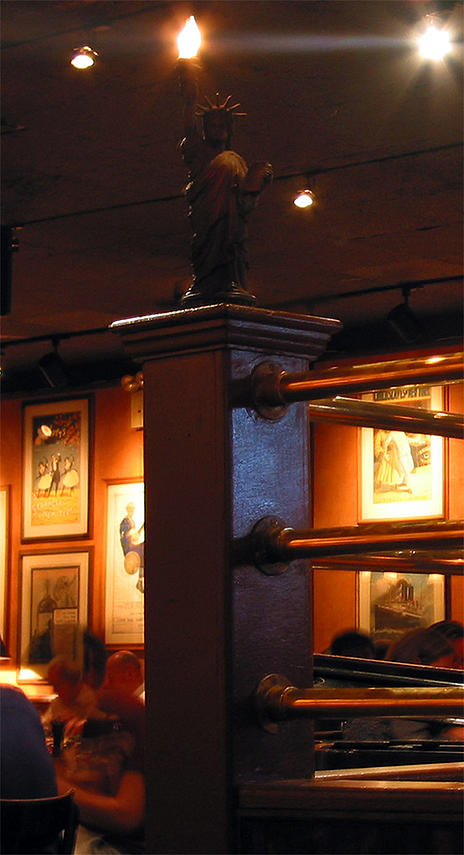
keens_lincoln.jpg 

My girlfriend, son and I had a pre-theater dinner at Keens Steakhouse last week (past visits here & here). I ordered the incomparable Mutton Chop ($45.00), which I think is the best item on the menu. My girlfriend had the sirloin (43.50), which wasn’t quite as tender it should be.

Keens is one of the few NYC steakhouses that offers prime rib. The only option shown on the dinner menu is a so-called King’s Cut ($49.50). The perceptive server guessed that a twelve-year-old probably wasn’t going to finish such a massive portion, so he offered us the English Cut ($28.00), normally served only in the downstairs “pub”.

Fries ($8.00) could easily become addictive. We didn’t order a bottle of wine, but a glass of the respectable house cabernet was a remarkably cheap $8.50.

While the time-warp ambiance at Keens is matchless, its steaks are a notch below other places in town while being several dollars more expensive. The huge two-story space is built for volume, and servers aren’t as attentive as they should be. But for the mutton chop or the prime rib, Keens is always worth the occasional visit.

Keens Steakhouse (72 W. 36th Street between Fifth & Sixth Avenues, West Midtown)

Food: *½
Service: *
Ambiance: **
Overall: *½

Update: Staghorn Steakhouse

staghorn_inside3.jpg
Kalina via Eater

I returned to Staghorn Steakhouse recently for a pre-theater dinner. From a previous visit, I recalled the relatively quiet atmosphere with widely spaced tables, which I thought would be conducive to a family conversation. I didn’t expect it to be quite this quiet: on a Saturday evening, it was practically dead when we arrived shortly before 6:00. It livened up a bit—but only a bit—by the time we left.

At $37.95, the steaks here are priced slightly below the NYC average. We found two hefty fillet mignons, a Kansas City strip, and a humongous rib steak, all top-notch, along with asparagus ($10.50) and mashed potatoes ($8.95). Two especially thick strips of Canadian bacon ($5) were wonderful. I was also pleased to find a good Côtes du Rhône for $45, which by steakhouse standards is not bad at all.

In short, everything at Staghorn Steakhouse was more impressive than last time. I am not sure which visit was more typical. 

Staghorn Steakhouse (315 W. 36th Street between Eighth and Ninth Avenues, West Midtown)

Food: *½
Service: *½
Ambiance: **
Overall: *½


Craftsteak

craftsteak_logo.jpg 

Craftsteak had a tough start, with most of the reviews citing the same peculiar flaw: the kitchen didn’t know how to cook a steak. With prices running about $10–20 per steak higher than the going rate in Manhattan, that wasn’t going to fly.

I visited Craftsteak 1.0 twice (here, here). Frankly, I might not have bothered to return after the first time, but I was so sure Tom Coliccio would right the ship that I figured it was worth another look. The second visit was, if anything, even worse than the first. I was still sure that Coliccio would fix it somehow, but I wasn’t going to rush back.

Tom Coliccio got busy. He fired his chef de cuisine, bought new kitchen equipment, and continued to tweak the menu. His efforts finally paid off with a rare re-review from Frank Bruni, elevating the restaurant to the two stars that I’m sure Coliccio intended it to have. More than a year after my last visit, I thought it was time to give Craftsteak another try.

Craftsteak 2.0 is much improved, though not without its flaws. The menu is still far too sprawling, with 20 different steaks and 35 side dishes. Ten of those steaks are variations on the New York Strip — corn-fed, grass-fed, or Wagyu; 10, 12 or 18 ounce; aged anywhere from 28 to 65 days. Who needs so many options?. Coliccio should offer New York Strip the two or three ways he thinks are best, and ditch the others.

craftsteak01a.jpg craftsteak01b.jpg

The amuse-bouche was a bit of a dud: a thin pâté buried too deep in a cast-iron bowl, with just three skimpy crackers to mop it up with. Parker-house rolls were much more successful, and it was all we could do not to eat all six of them.

craftsteak02.jpg

craftsteak03a.jpg craftsteak03b.jpg

Our favorite steak is the ribeye: naturally, there are two versions: 14-ounce grass-fed ($55) or 18-ounce corn-fed ($52). We chose the latter, as it’s four ounces heavier and three dollars cheaper. And finally, Craftsteak served a steak for the gods: tender, beautifully charred, evenly marbled, full of mineral flavor. There was no need for four steak sauces: they were first-class, but why offer only two spoons?

Rounding it out was a plate of gnocchi ($11), soft, light and creamy enough to make you forget every other gnocchi you’ve ever had.

The dining room was full, but we had no trouble getting walk-in seating at the bar. The tables there are just as big, and it’s the same menu. Servers aren’t quite attentive enough. I would almost be tempted to award three stars for the food, if I did not suspect that a menu as vast as Craftsteak must have some duds, and perhaps we were just lucky enough not to order any of them. But on the strength of this visit, it appears that Craftsteak is finally delivering on its promise.

Craftsteak (85 Tenth Avenue at 15th Street, Far West Chelsea)

Food: **
Service: *½
Ambiance: **
Overall: **

TBar Steak & Lounge

tbar_inside.jpg
I found out about TBar Steak & Lounge via an Eater post, which lampooned the place for its dorky décor. I wouldn’t normally go to the Upper East Side for a steakhouse, as there are plenty of great ones in my neck of the woods, but hey, I was feeling adventurous.

The good news is that it’s nowhere near as dorky-looking in real life as it looks in that Citysearch photo. And the restaurant seems to be doing well. When I walked in at around 6:00 p.m. on a Thursday without a reservation, they could seat me only in the lounge. That was just fine: the lounge is spacious and comfortable.

The bad news is that they’re serving USDA Choice at a Prime tariff.

tbar01.jpg
I took one bite of my Ribeye Steak ($42), and I knew immediately it wasn’t headed for the pantheon. The conversation with my server was almost surreal.

“Excuse me. Is this prime or choice?”

She looked at me with a puzzled stare. “In terms of…what?”

“Have you heard of Prime beef, versus Choice beef?”

“Uh, no.”

“Can you ask the kitchen if it’s Prime or Choice?”

By this point, I already knew the answer. At any restaurant serving Prime beef, the servers know it. Her response, a few moments later, was just a formality: “It’s Choice.”

For a Choice steak, it wasn’t bad. But it was $42, which is as much as, or more than, many restaurants charge for aged Prime. Any steak-lover will instantly know the difference.

I also ordered the Potato Cake ($12), a luscious creation made with potatoes and gruyère (upper left in the photo). Servers were young and friendly. And obviously not schooled in the difference between Prime and Choice.

TBar Steak & Lounge (1278 Third Avenue between 73rd & 74th Streets, Upper East Side)

Food: Satisfactory
Service: Satisfactory, but the servers aren’t meat scholars
Ambiance: Good
Overall: Overpriced, for what they’re serving

Posted on Tuesday, October 23, 2007 at 08:31PM by Registered CommenterMarc Shepherd in , , | Comments2 Comments | EmailEmail | PrintPrint

Primehouse New York

primehouse_logo.jpg

It was only a matter of time before Stephen Hanson, that past-master of formula restaurants, opened the ultimate formula restaurant, a steakhouse. David Burke’s Primehouse opened in Chicago last year, and now comes Primehouse New York, sans Burke, but with a very similar steak program.

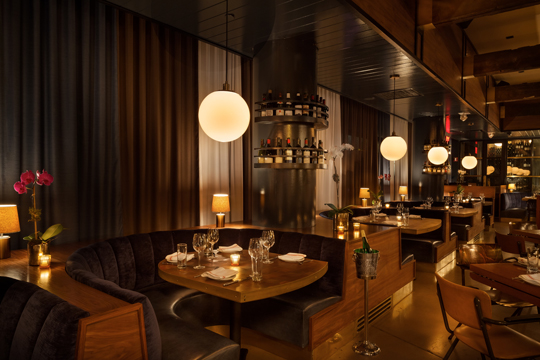
Primehouse has a more modern vibe than the average steakhouse: a quieter version of BLT Prime. Booths and tables are more generously spaced than at BLT, and there are soft surfaces to absorb the sound. The space feels “dressy” by steakhouse standards. You could bring a date here, and have a conversation without shouting.

There weren’t any tables available when I walked in at around 6:00 p.m. on a weeknight, but the bar area is large and comfortable, with soft, high-backed chairs. Bar dining must have been planned from the beginning, as these are about the plushest bar seats you’ll find anywhere in town. Once you sit down, you’ll want to stay a while.

The menu offers typical steakhouse starters ($8–18), a raw bar (platters from $16–79), seven cuts of steak ($34–49) plus porterhouse for two ($86), eight other meat and fish entrées ($21–42), and side dishes ($9). At $46 for a ribeye and $48 for a New York Sirloin, Primehouse sets the high water mark for NYC steakhouse pricing (though the now-closed V Steakhouse was worse).

primehouse01.jpg

Are those stratospheric prices worth it? If the 20-ounce “Kentucky” bone-in ribeye aged 28 days (which my server recommended) was any indication, they just might be. The mineral tang of the dry aging was all you could ask for, and the marbling was as even as on any ribeye I’ve encountered. The kitchen executed without fault, with a deep char on the exterior and a perfect medium rare inside.

I also tried the Smoked Bacon Brussels Sprouts (top right corner in the photo). I liked how the musky taste of burned bacon enhanced the sweetness of the Brussels Sprouts, but the bacon bits themselves were tough and tried out.

The wine list is a large tome, and only high-rollers will be pleased. The reds go on for many pages, but I counted only seven bottles under $60, and only two under $50. None of the California Cabernets were under $60, and none of the French Bordeaux were under $80. If Café Boulud can offer an entire page of red wines under $60, it’s hard to believe that the prices at Primehouse are justified. I was glad to see a page of half-bottles, which one seldom sees at a steakhouse; more restaurants should have them.

Is Primehouse New York for you? It depends on whether you mind spending a few dollars more for a commodity item. But if future visits confirm that the ribeye I enjoyed was no fluke, then Primehouse just might be a top-tier steakhouse.

Update: Since this review, Brian O’Donohoe has replaced Jason Miller as chef. We doubt that this will make a tremendous difference to the average diner, but it is worth noting that O’Donohoe has stints at Le Bernardin, Barça 18, and Fiamma on his resume. Perhaps seafood dishes here will be worth a closer look.

Primehouse New York (381 Park Avenue South at 27th Street, Gramercy)

Food: **
Service: **
Ambiance: **
Overall: **

Staghorn Steakhouse

staghorn_inside1.jpg

I’m on a mission to try all of the steakhouses in town. The other day, it was Staghorn Steakhouse’s turn.

Before I even tasted a morsel, I was struck by the austere décor. Frank Bruni (on his blog) thought that it was built on-the-cheap. I took it as a considered decision to break out of steakhouse clichés, and I’m glad they did. The blonde wood floors, white walls, and generously spaced tables made the space feel more relaxing than most other restaurants of its kind.

staghorn_inside2.jpgService, however, was right out of the steakhouse playbook. Bread rolls were cold and stale. When I asked about wines by the glass, the waiter blurted out a list of grapes (merlot, shiraz, cabernet, pinot noir, chianti), but there was no printed list so that you’d know which shiraz they were serving. No other restaurant in its price range would be so cavalier about wines, but nearly all steakhouses seem to do it.

The meat entrées were the usual items, at the usual prices. I ordered the prime bone-in ribeye ($36), which was nicely charred and a perfect medium rare, but not quite as tender as some other ribeyes I’ve enjoyed, and marred by gristle in a couple of spots. I don’t hold the restaurant entirely accountable for this, as these days there are too many buyers chasing not enough beef. The server informed me that the steak was aged on-site for 28 days, which seemed believable.

The seafood menu (though I didn’t sample it) looked a bit better than some other steakhouses, including a Dover Sole and a Grilled Whole Branzini.

The restaurant wasn’t particularly crowded, although on a Thursday night in mid-August I wouldn’t draw any conclusions. However, the location isn’t in its favor. I’ve walked by a number of times, and it never seemed full. As Eater noted, Staghorn probably does good business before Knick and Ranger games. I don’t know if that’s enough to stay in business, but as it’s on my way home, I’ll probably be back.

On the strength of one visit, Staghorn Steakhouse seems a notch below the city’s better steakhouses, but it’s certainly respectable, and its calmer ambiance might be just right for some occasions.

Staghorn Steakhouse (315 W. 36th Street between Eighth and Ninth Avenues, West Midtown)

Food: *
Service: Satisfactory
Ambiance: **
Overall: *

Smith & Wollensky

smith_wollensky.gifSmith & Wollensky isn’t quite the dean of New York steakhouses, but at thirty years old, it predates most this city’s beef emporiums. There are now S&W’s in nine cities. In New York alone, the same restaurant group also owns Post House and Quality Meats, in addition to the flagship at 49th & 3rd.

I believe I paid my first visit to S&W around fifteen years ago. My only recollection is the after-dinner cigars we enjoyed at the bar, an experience that couldn’t be reproduced today. A few weeks ago, a friend visiting from out of town was in a steakhouse mood. We chose S&W, as it was near his hotel.

S&W offers the same generic menu, at the same generic prices, that you find at most New York steakhouses. We both ordered the filet mignon, which came in a huge double portion. It was charred, nicely aged, and prepared to the correct temperature. The server was no doubt aware that it came with an ample helping of vegetables, but he didn’t mention that as we ordered an entirely unnecessary side order of creamed spinach.

The décor is unremarkable. When I wandered around looking for the restroom, it struck me that the upkeep was a bit sloppy, with various carts and trays left lying around in a hallway.

Smith & Wollensky has enjoyed four full New York Times reviews—a remarkable achievement for a formula restaurant. In December 1977, shortly after it opened, Mimi Sheraton rated it “Fair.” The format has apparently changed over time, as Sheraton described Smith & Wollensky as an “Italian steakhouse,” and there certainly is no vestige of that today. For the record, there never was anyone named Smith or Wollensky; the founder, Alan Stillman, chose those two names at random out of a Manhattan telephone directory.

In 1986, Bryan Miller upgraded the restaurant to “Satisfactory,” and then again in 1990 to one star. In its most recent review, in 1997, Ruth Reichl called it “A Steakhouse to End All Arguments,” awarding two stars. It was a peculiar headline, given her admission that she preferred Peter Luger (to which she had awarded three stars). To her, the difference was that at Smith & Wollensky you could order a fish entrée, and not feel like it had been an afterthought.

In  the last several years, there has been a glut of new steakhouses. Many of them mindlessly follow the traditional format, but a few have actually improved on it, such as BLT Prime, Porter House, and S&W’s sister establishment, Quality Meats. I suspect even Ruth Reichl would agree that, these days, a traditional steakhouse needs a little something extra to win two stars. These newer restaurants have it; Smith & Wollensky does not.

Smith & Wollensky (797 Third Avenue at 49th Street, East Midtown)

Food: *
Service: Fair
Ambiance: *
Overall: *

Page | 1 | 2 | 3 | 4 | 5 | Next 10 Entries