
Friday
Apr122013

La Stüa de Michil

On our trip to the Dolomites, our second Michelin-star restaurant was La Stüa de Michil in the La Perla hotel, in Corvara, Italy.

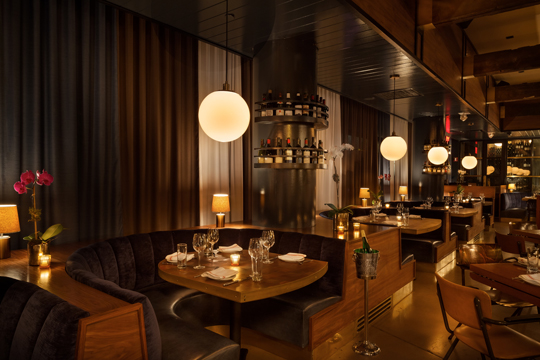
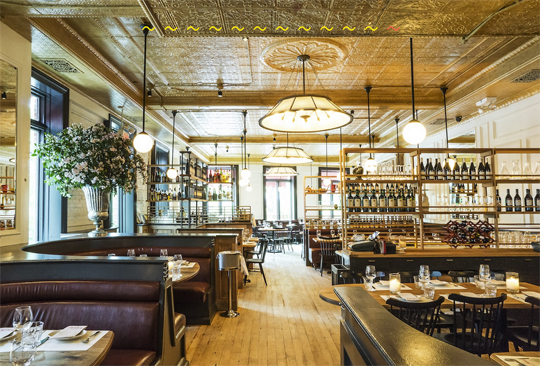
This place is distinctly old-fashioned, with a dimly-lit dining room that looks like a reconstructed mountain cabin. Servers wear traditional outfits and don white gloves whenever they replace the silverware on your table.

In the basement is a museum of Sassicaia, an elite Super Tuscan that makes Barolo look cheap. But the wine list is stupendous, with plenty of options at every price. A 1997 Morometo Frescobaldi (€58) was the best wine we had all week.

We arrived early and ordered an Aperol spritzer before dinner, which came with a selection of pretty remarkable bar snacks that would have sufficed as the amuses bouches at most restaurant—but once seated in the dining room, there was another round.

We ordered from the carte: and the price of dinner for two was €272, including the wine. By a slight margin, the food was at a higher level than at La Siriola the preceding evening, although the secondi didn’t quite live up to the pyrotechnics of the other courses. The primi, although simple-looking, bursted with intense flavor.

As I noted in the previous review, this was a pleasure trip and I didn’t care to take detailed notes. Enjoy the slideshow. Brief descriptions of the dishes are on the Flickr site.

La Stüa de Michil, La Perla Hotel, Corvara, Italy

Friday
Apr122013

La Siriola

My son and I recently took a week-long ski trip to the Dolomites region of Italy. Naturally, I checked if there are any Michelin star restaurants in the area. Had there been a great many, I would have had to choose; as there are only three, I decided to try them all.

They’re in luxury hotels, within about 20 minutes’ drive of one another. Starred restaurants are like that; they tend to be found in clumps. Quite by accident, I managed to book them in increasing order of merit. Having said that, they were all wonderful. I’d happily visit any of them again.

I wanted this trip to be pleasure, not work, so I didn’t take detailed notes. I am going to post brief impressions, along with a slideshow of each place.

At La Siriola (“nightingale” in Ladin, the indigenous language), there’s a carte, or you can choose (as we did) one of four, four-course set menus, with names like “Hay” and “Moss” (€98 apiece), which include a bounteous bread service, multiple amuses bouches, pre-desserts, petits fours, and so forth, a glass of sparkling wine, and a shot of grappa at the end.

A wonderful 2004 Sacrisassi Rosso from Le Due Terre was €42. I can’t imagine finding that in New York.

The dining room is decorated in rustic elegance, with walls and ceilings of blond wood and white plaster. We were seated in a comfortable alcove, and were well taken care of. The full price of dinner for two, including wine, was €272.

Enjoy the slideshow.

La Siriola, Hotel Ciasa Salares, Armentarola, S. Cassiano, Italy

Friday
Apr122013

The Bazaar by José Andrés, Beverly Hills

Last November, we paid a visit to The Bazaar in Beverly Hills, the tapas brasserie by José Andrés. It’s hard not to be a bit cynical, given how thin the chef has spread himself (ten restaurants in four cities).

The Bazaar is a high-concept, high-gloss space that seats 678. How he keeps up the quality is a considerable mystery, but he does it somehow. Almost everything we tried was excellent. There was one dish I disliked — a take on shrimp cocktail, where you squirt the cocktail sauce into your mouth with a plastic eyedropper. But I took that to be an error of conception, not of execution.

The four-page menu is divided into two parts, traditional tapas and modern tapas. Most items are in the $10–15 range and suitable for sharing, but you’ll need a bunch of them. Our party of four ordered about fifteen of these (some in double portions). As I recall, the kitchen sent them out at a reasonable pace, and in a reasonable sequence.

In lieu of detailed descriptions, I offer a slideshow below. You’ll have to visit the Flickr website to read the photo captions (a limitation of their system, I’m afraid).

The Bazaar by José Andrés
SLS Hotel Beverly Hills
465 South La Cienega Boulevard
Los Angeles, CA 90048


Monday
Apr082013

Cherrywood Kitchen


Cherrywood Kitchen is a cute new neighborhood spot that could bring good food and great fun to an area that has been historically under-served.

A lot of restaurants have struggled to find a following here, in Hudson Square, the neighborhood bounded by the Holland Tunnel, Houston Street, Sixth Avenue, and the Hudson River. Some people call the area West Soho, but it’s far enough west that people don’t tend to wander over without a good reason.

Cherrywood’s entrance, on a side street, isn’t ideally placed. You’re not likely to stumble upon it. Once you get there, you’ll probably enjoy it. The cuisine isn’t meant to be pathbreaking, but a couple of dishes have the potential to be knock-outs.

The owners have gone all-in on the cherry wood concept, which features not only in the cooking but also the décor. Inside, it isn’t quite as red as the photos (above) would suggest, but the space could use a dash of whimsy.

The publicity materials emphasize chef Chris Cheung’s apprenticeship at Nobu and Jean Georges, but more recently he’s taken turns at quite a few other places, including a stint at Monkey Bar (pre-Graydon Carter), and the short-lived WallE with the Chin brothers. He has been, perhaps, ill-served by some of these projects.

The eclectic menu here is concise and takes a decidedly populist bent, with dishes labeled snacks ($5–14), small plates ($11–14), large plates ($21–46), sides ($5–8), and desserts ($8–11). The cuisine spans many cultures while being beholden to none; an Asian accent is detectable at times, not a surprise given the chef’s background.

With such dishes as Salmon Head Salad and Eel Stuffed Freshly-Killed Chicken, he’s not afraid to challenge the diner, though many other dishes are far more straightforward (braised lamb shoulder, smoked ribs). Most of the entrées are under $30. They are, in general, not unreasonably priced for the area, but a $21 burger strikes me as audacious.


The house-baked ciabatta, the size of a large grapefruit, with blue cheese butter (above left), is a highlight, instantly entering the pantheon as one of the best bread services in town. Lobster Tacos ($14; above right) offer a crunchy snack, although I wanted more flavor out of the lobster.


I’m a sucker for appetizers that feature freshly poached eggs, and this one ($14; above left) didn’t disappoint, here served with smoked asparagus and a generous helping of Serrano ham. The table gave nods of approval to the Garlic and Shallot Soft-Shell Crabs ($26; above right) with baby artichokes.


“Fresh-killed” chicken has been turning up on menus lately. (Jeff Gordiner, in a piece for The Times, explained exactly what that means.) At Cherrywood, perhaps more notable than the chicken’s death certificate is the eel stuffed under the skin, which imparts a terrific smoky flavor.

A side of French Fry Ends ($7; above right) with a bacon crumble sounded better than it was. Better eaten with a spoon than a fork, it needed a binder, perhaps cheese, to prevent its constituent parts from rolling away.

The wine list is a typical starter set of about 20 bottles (per the website; I think it was fewer when we visited). If you’re at the bar, order the excellent sangria (normally $12/glass, although we weren’t charged).

The restaurant was not crowded, although a Wednesday evening, at a restaurant that was only about a week old at the time, is hardly an indication of a typical crowd. We were treated well: it’s only fair to note that I was recognized.

The chef’s experiments aren’t all successful, but there are enough hits to make Cherrywood Kitchen well worth a visit if you’re in the area.

Cherrywood Kitchen (300 Spring Street, west of Hudson Street, Hudson Square)

Food: An eclectic American menu with global accents
Service: Friendly, enthusiastic
Ambiance: A handsome, dark-wood look; a comfortable space

Rating: Neighborhood Spot

Tuesday
Mar262013

Oficina Latina


If it were in any other U.S. city, Oficina Latina (opened 2½ years ago) would be one of the funkiest, hippest places in town. In New York, you might imagine that it’s just another Pan-Latin spot that you never heard of, though you would be overlooking its many charms.

The décor—really indescribable—is inspired by the Pan-American Highway circa the 1950s. The connection isn’t entirely clear: there’s a pressed tin ceiling recovered from a 1920s bank, various species of mismatched vintage furniture and light fixtures, a barber’s chair at the bar, marble and wrought iron tables, and distressed painted brick walls.

It’s not fancy or expensive: you can have brunch every day for just $12; add a Margarita or Bloody Mary, and it’s all of $15. Dinner will run you a bit more, but not a lot, with tapas $8–15, soups and salads $8–12, tortas $12–22 (but most under $15), mains $20–23.

The cuisine is not aligned to any particular Latin-American country: the chef is Mexican, the owners Italian. The publicist (at whose invitation I visited), says the menu is expected to be rewritten shortly: they’re going to shorten it a bit, and make room for rotating specials.

The bar and cocktail program deserve more exposure. There’s a selection of 100+ tequilas and mezcals, and another 100+ rums and piscos, many offered with custom infusions. A pepper-infused mezcal (right) garnished with a chili pepper was terrific. So was another, made with ancho and lychee.

But the printed menu offers just clichés like mojoitos, piña coladas, and margaritas. The printed specialty cocktails are flavored versions of these (e.g., a blackberry caipirinhas) that sound truly depressing. The beverage director (and co-owner), Paolo Votano, ought to flaunt his better stuff.

While the menu is being re-done, perhaps they’ll improve the plantain chips (above left) that begin the meal: they don’t have enough heft to stand up to the spicy dipping sauce they come with.

But there weren’t many other off-notes to the meal, which showed a kitchen of some accomplishment, especially when it can put the charcoal grill to good use.


Grilled octopus (Pulpo a la Parrilla, above left), served with a cilantro dressing, with a potato and celery salad, had a luscious smoky flavor. There was plenty of warm smoke, too, in tacos with roasted suckling pig (Tacos de Puerco, above right), crackling skin, grilled lime and sliced avocado.


I love blood sausage when it’s done right (Abrebocas, above left), but this preparation was too loose: it oozed out of the casing, like toothpaste, when you tried to cut into it. Chorizo was fine, but unremarkable.

A roasted deboned half-chicken in a garlic sauce (Pollo a la plancha, above right) was tender and full of flavor, probably from that same charcoal oven.


Chili caramelized pineapple (Pina Picante Caramelizada en Agave, above left) was a first-rate dessert, paired with the oddest after-dinner drink I’ve seen: “Passionate Love” (above right), consisting of rum straight-up with lemon wedges that you dip in strips of powdered sugar, cinnamon and coffee, laid out to resemble lines of cocaine.

I can’t comment on the service, since the meal was comped, but the 62-seat dining room was about two-thirds full by 9:00 pm on a Monday evening, so the restaurant apparently has a local following.

I’ve no way of knowing whether the rest of the over-long (and soon-to-change) menu is as interesting as the small sample that we tried. If you order the octopus, the suckling pig tacos, and the chicken, you’ll go home happy.

Oficina Latina (24 Prince Street between Mott & Elizabeth Streets, NoLIta)

Monday
Mar252013

Carbone


Periodically, the New York food media anoints a new chef-god — a creature (usually young and previously unheralded) who is, for a while, infallible. The blogs and critics drool and pant at every move he makes. What it is, doesn’t matter. Broccoli? Brilliant!!

Right now, the god du jour is two-headed: Rich Torrisi and Mario Carbone, the chef-savants behind Torrisi Italian Specialties and Parm. Up to this point, the exact reason for their deity status was beyond me. At the first restaurant, I found a $50 prix fixe menu (since hiked to $75) severely overrated. At Parm, Pete Wells awarded two stars for a meatball hero, and not much else.

If you haven’t guessed, when the boys opened their latest spot, an old-school Italian–American joint called Carbone, I didn’t join the heavy breathing, although Eater.com and the notorious Torrisi shill, Kate Krader, did enough for all of us combined.

Having invested several years of deep skepticism in the Torrisi phenomenon, I was prepared to hate Carbone. To my surprise, I loved it. Will you? It depends.

Carbone is very expensive. Antipasti are $15–34, soups and salads $15–21, pastas $19–32, mains $29–53, side dishes $10. My bill for one came to $145 before tip. I drank modestly and by no means over-ate. Tabs over $200 per head won’t be uncommon here.

Much of the menu is straight out of the classic Italian–American playbook: Shrimp Scampi, Linguine with Clam Sauce, Veal Parmesan. There’s an insulting term for that style of cooking, which I refuse to use. It conjures images of machine-made pasta out of a box and tomato sauce out of industrial-size cans.

This has led to the perception that the genre is inherently simple and seldom worthwhile. But does Italian–American cuisine have to be that bad? Or is that merely a consequence of it being so popular? Have Olive Garden and streetside hucksters in Little Italy warped our perceptions of what the cuisine could be, when done well?

There’s also a perception that the genre is a mongrel interpretation of the cuisine that unsophisticated immigrants brought with them from Italy and then modified, so it’s not really Italian, and therefore is illegitimate.

So that’s the dilemma. If you think Italian–American cuisine is a bastard genre that requires no skill, Carbone’s $50 Veal Parmesan will seem to you an exercise in craven cynicism—a $25 dish that costs double due to the chefs’ outsized reputations. You’d be wrong, but I’m not going to talk you out of it. Just don’t go to Carbone. You’ll hate it.

When I look at Carbone, I see a beloved genre impeccably recreated, treated with respect, and then improved. They get almost everything right, but they make you pay. Oh boy, do they make you pay.

The cocktail list (above left) offers straightforward classics at $17 a pop, but like the food, they’re exactly right. A Gibson on the rocks was served with one of those two-inch-square ice cubes that the high-end cocktail bars use, so that it won’t dilute the drink.

Wines by the glass are just as expensive. Most reds are above $20 per glass; three out of seven are from California, a blunder that needs to be corrected. Prices by the bottle are in a wide range, with most over $65.


No one will call Carbone a bargain, but but the pre-meal extras are generous: a slice of parmesan (above left), American smoked ham (above center) and warm “gramma” bread with tomato (above right), served on one of the most vibrant china patterns I’ve seen in a while.


Pickled vegetables in olive oil (above right) didn’t do it for me: they reminded me of a failed dish at Torrisi Italian Specialties. Then came three more kinds of bread (above right): imported breadsticks, garlic bread (needed to be warmer), and sesame.


Asparagus Genovese ($16; above left) in a pool of warm stracciatella wore a cloak of prosciutto: a classic impeccably done.

Although not indicated on the menu, the kitchen will prepare half-orders of pasta. I decided to try the most cliché of them all, Spicy Rigatoni Vodka ($11.50; above right). The preparation was elevated by the crunch of shaved breadcrums (along with pecorino romano). I also liked the heft of a large meatball ($6; below left).


Veal Marsala ($52; above right) was the best damned veal chop you’re going to find, coupled with the best mushroom orgy you’re going to find.

The meat dishes appear to be uniformly good. Lamb chops ($49), which I saw at the next table over, were massive. The server showed me an uncooked 60-day dry-aged t-bone ($53), which looked to be about an inch and a half thick.


The pre-dessert (above left) was a pastry with powdered sugar. The server brings around a dessert cart, just like the old-fashioned places; the choices are obvious classics. A cheesecake with blueberry compote ($12; above right) was superb, with the consistency of soft butter.

The décor and ambiance have received so much fawning coverage that there’s hardly anything to add. You’ve seen it before—except, not quite. What other Italian–American spot has contemporary artwork “curated” by Vito Schnable, and vintage tuxedos “designed” by Zac Posen? The sound track consists of softies and oldies: “Puttin’ on the Ritz,” “That’s amore,” “Mr. Sandman,” “Stand by me.”

Servers reel off daily specials, and they’ve been trained to upsell. But they do keep an eagle eye on the proceedings, and many dishes are portioned or finished tableside. Whoever runs the front of house has trained them well.

Carbone occupies the space that was formerly Rocco’s, an old-school joint, of the sort Carbone is meant to pay homage. The bar is so tiny that they don’t even have room for stools, and it can get crowded. Reservations have been tough to come by; calls to the published telephone number often go unanswered. I walked in at 5:30pm on a Thursday evening and was seated immediately, but an hour later that probably wouldn’t have worked.

Some people, without question, will find the concept offensive: tired old standards at double the price, as one message-board poster put it. If that’s your perspective, Carbone isn’t for you. But if you like the idea of the classic Italian–American restaurant lovingly reacreated and improved, Carbone is brilliant.

Carbone (181 Thompson St. between Houston & Bleecker Streets, Greenwich Village)

Food: Italian–American classics, impeccably done
Service: Classic and correct
Ambiance: Old-school Little Italy, not exactly as you remembered it

Rating: Category Killer

Monday
Mar182013

Le Philosophe

Welcome to Ground Zero of New York’s French revival: Le Philosophe, a mash-up of haute barnyard tropes (lists of purveyors scrawled on a blackboard) and a menu Escoffier might recognize.

So far the critics are loving it, which for a French restaurant is remarkable. Robert Sietsema of the Village Voice, Ligaya Mishan of The Times, and Adam Platt of New York are among those who’ve filed raves. (If Platt has ever liked a new French restaurant before, I cannot recall it.)

The space was recently the short-lived noodle shop Hung Ry. In a quick re-do, they left the bar and the open kitchen practically as-is, bringing in dark wood tables and decorating the walls with photos of famous French philosophers. Dinner is on the house if you can name them all.

The chef is Matthew Aita, who worked under Jean-Georges Vongrichten and Daniel Boulud. He serves dishes like Lobster Thermidor, Tournedos Rossini, and Duck à l’orange that probably haven’t been seen together on a restaurant menu since the Nixon Administration. It gives a whole new generation the chance to discover what they have been missing.

You wonder why no one has thought of this idea before: reviving the classics in a modern casual setting that could have been a Momofuku with tables, Perla, or Cookshop.

The ambiance is a hybrid too: reservations are taken and coats checked, but at the bare-bones bar, the metal stools are the kind that make your thighs go numb.

There are about nine appetizers ($6–18), a similar number of entrées ($18–36), and a few vegetable sides ($6). Most of the mains are $25 and under, except for the lobster, the tournedos, and the duck.

Thursdays to Saturdays,, there’s a more limited late-night menu served till 1 am.

The wine list may be the most inexpensive I’ve seen in years, with bottles as low as the teens (though you could spend much more) along with a couple of dozen beers by the bottle. Wines by the glass are also inexpensive (as low as $6.50) and pours are ample, but the selection is meager.

The meal begins with two kinds of bread and soft butter (above right) — not made in house, as far as I can tell, but just fine for this sort of place.


Roasted Bone Marrow ($12; above left) was the third rendition of this dish that I’ve had in the last month, and I can’t imagine it done any better. A long bone trench is roasted, sliced in thirds, and topped with a spicy relish of shallots, lemon, capers, and watercress, with toasted warm country bread on the side. There’s oodles of gelatinous marrow, so rich and hearty it could be a meal in itself. Just wow.

Unctuous duck à l’orange ($27; above right) is sliced into triangles resembling hamentashen over a silky potato purée. The duck was just about perfect, but the orange sauce was too meek: it hardly made an impression.

Service was a bit on the slow side, but not to the point it became annoying. The restaurant was mostly full at 6:00 pm on a Sunday evening, which bodes well for the longevity of this place. Le Philosophe is a hit, and deserves to be.

Le Philosophe (55 Bond Street between Lafayette Street & Bowery, NoHo)

Food: French classics, modern preparation
Service: Can be slow when busy, but good enough
Ambiance: Benoit meets Cookshop

Rating: Critic’s Pick
Why? For skillfully reviving classics that almost no one in town serves any more

Sunday
Mar172013

Spina

Spina is an off-the-radar trattoria on a bright corner lot in Alphabet City. Opened in 2009, it wasn’t reviewed professionally, but it managed to attract a 25 food rating on Zagat, good enough for the top 7 percent of Italian restaurants city-wide. To put that in perspective, Marea is a 27, and Babbo is a 26.


As Spina gets no substantial food press, I imagine its popularity is drawn mainly from the neighborhood, and it is easy to see why. The décor out of the faux rustic playbook is comfortable and inviting, the menu is inexpensive, the food good for the price, and the wine list well worth exploring.

Spina is on its third chef in four years (currently Joe Marcus, a Picholine and Café Boulud vet), but it is not struggling by any measure: the dining room was nearly full by 8:00 pm on a Tuesday evening. Nevertheless, we were invited to come in for a tasting (and did not pay for our meal).

The concise one-page menu offers various appetizers and salads ($8–14), pastas ($16–22), mains ($19–24) and vegetable sides ($6). With nine pastas to just four mains, it’s clear that the former are meant to be the restaurant’s focus. The work station where the noodles are made in-house is in the dining room itself.


A wonderful poppy seed focaccia (above left) is also made in house; they serve it with a soft, truffle ricotta butter.

The winter salad ($11; above right) was well above the routine, with shaved brussels sprouts, avocado, cranberries, apples, pumpkin seeds, parmigiano reggiano, and lemon dressing.


The unusual wild mushroom goat cheese polenta ($11; above left) was the best of the appetizers, well above anything you’ll find in the average trattoria.

It seems everyone has to offer meatballs these days. Spina’s rendition of them ($8; above right) is acceptable but not distinguished: veal, beef and pork, with a light tomato sauce and parmagiano reggiano. Still, it’s worth noting that we paid $15 for meatballs at The Cleveland a couple of weeks ago, for a recipe that wasn’t as good.

We concluded with a tasting of three pastas. From left to right: 1) black pepper pappardelle with wild boar ragù ($18); 2) basil malfati with house-smoked tomato, eggplant, garlic, and fresh ricotta ($16); and malloreddus ($17), a saffron-infused corkscrew pasta called gnocchetti with a veal and pork tomato ragù.

None of these will put Michael White out of business, but the execution is well beyond the average neighborhood trattoria. If you can order just one, try the malloreddus, which you aren’t going to find just anywhere. The malfati are also worthwhile. The pappardelle with wild boar ragù struck us as a tired cliché, but a neighborhood spot needs to offer some comfortably familiar items.

The 16-page international wine list is remarkable, with prices ranging from $32 to $465. A steady stream of high rollers must justify the higher end of the list, but there is plenty for those who want wines priced in line with the food. Wine director Matthew Harrell has made a specialty of the Finger Lakes region, but his eclectic tastes range from Slovenia, Lebanon, and Greece, to Austria, France, and of course Italy.

We can’t comment directly on the service, since this was an invited visit, but Harrell seemed to spend as much time evangelizing the wine list at other tables as he did at ours. He served us ad hoc pairings of several wines by the glass, which I assume he does at other tables, as well.

With hundreds of Italian restaurants in the city, it is difficult for any to attain destination status. Spina is certainly a very good one, and in conjunction with the excellent wine list, certainly well worth exploring if you’re anywhere near the East Village.

Spina (175 Avenue B at E. 11th Street, East Village)

Tuesday
Mar122013

Arlington Club


I never realized how desperate the Upper East Side was for a great steakhouse. Laurent Tourondel did. He opened Arlington Club on Lexington Avenue four months ago and scored a bullseye: an instant hit.

You’d figure Tourondel can nail a steakhouse. His BLT Steak (opened nine years ago, and since replicated in a dozen cities) practically defined the modern steakhouse movement: the appetizers and non-steak entrées are terrific, and you swoon over the side dishes as much as the steaks themselves.

Since the failure of Cello, an old-school three-star seafood restaurant, in 2002, Tourondel has been more obsessed with replicable populism than excellence. The man can cook, but who runs the show when he is absent? All of his post-Cello places have been bedeviled with inconsistency.

And none of them have had management that complemented Tourondel’s skill in the kitchen. His BLT partnership with the restaurateur Jimmy Haber ended in an acrimonious divorce in 2010. Now he’s in bed with the Tao Group, the geniuses behind a chain of terrible, but highly profitable, restaurants, such as Tao, Lavo, and Marble Lane. If Tourondel is half the perfectionist he is reputed to be, it’s hard to imagine how he’ll tolerate being beholden to these clowns.

For now, Arlington Club is BLT Lavo, neither as bad as the Tao group’s other outfits, nor as good as it could be if Tourondel ever found the right partner. Tourondel’s DNA is evident in the excellent steaks, the sides, and the heavenly popovers. Tao Group’s DNA is evident in the mediocre service, the clubby crowd, and the spectacular build-out—resembling, and as noisy as, a European train station.

I booked a 5:45 pm table on a Saturday evening. A host called to warn me that my party would not be seated if it were incomplete, and that the table would be forfeited after 15 minutes. That was after they already took a credit card number in advance. Never mind that, according to multiple critics, tables are frequently not available at the promised time. A restaurant that can’t keep to its own schedule has no business lecturing customers about punctuality.

At check-out, I was compelled to sign the bill twice, both before and after I presented my credit card. “It’s our policy,” said the server, who didn’t even try to explain it.

According to Bloomberg’s Ryan Sutton, bar tabs are not transferrable to the table—an inexcusable lapse at a restaurant where even modest eaters will struggle to keep the bill under $125 per person. The wine list offers a wide selection, from the low $50s up to four figures; but then, they’ll serve your super-Tuscan in the same glass as they’d serve a Pinot Grigio.

This is what you get when a respected chef goes into partnership with the Tao group: a restaurant practically designed to suck. But with Arlington Club perpetually packed these days, the money-vacuum at Corporate has no reason to change: they just keep hoovering up the dough.

Having said that, the service staff themselves were extremely good. The server gave excellent ordering advice; plates were cleared promptly, and the staff must have circled back half-a-dozen times to wipe crumbs off the table.

The food was fine, but not good enough to justify the Tourondel premium. The price of the menu’s centerpiece, the côte de boeuf, has been on a rocket’s trajectory: $110 in early January (when The Post’s Steve Cuozzo awarded three stars), $115 in mid-January (when The Times’s Pete Wells awarded two), $125 by the end of January (when Bloomberg’s Ryan Sutton awarded half-a-star), and $130 today. Most of the menu has seen a similar, if not quite as spectacular, an increase over the past few months.

At today’s prices, the menu offers a selection of sushi rolls ($12–21), raw fish and seafood ($14–28), appetizers ($14–26), steaks ($36–65 per person), composed mains, referred to as “specialties” ($26–59) and a wide assortment of sides ($11–15). The sushi, by the way, has been panned by all three of the pro critics that have reviewed it. We were not about to touch it with a barge pole.

The meal begins with the legendary popovers (above left), a feature wisely retained from the BLT franchies, served here (inexplicably) with pickles. The recipe has changed since we last visited BLT Prime, and I like these a bit less—they taste a bit too eggy—but they remain a highlight of dinner at any Tourondel restaurant.


Calamari Salad ($17; above left) and Fluke crudo ($14; above right) were competent but unremarkable.


That côte de boeuf (above; $130 for two), served with a trench of bone marrow, is very good and perfectly cooked to the medium rare we requested (not a guarantee here, given the comments of multiple pro reviewers). There’s an appealing crunchy char on the outside, although the meat doesn’t quite have as much dry-aged flavor as I’d like.


The steak comes with the French Fries (normally $10 if ordered separately). Full credit to the server for letting us know (the menu made no mention of them), and urging us to cancel a separate order of “Potatoes Arlington,” which would have been wasted on us. The fries are doused with an excess of cheddar powder and what the menu calls “spices,” which tasted to us like truffle oil. They were merely okay.

The Truffled Gnocchi ($15; above right) are superb, an expensive side dish well worth it.


There are about a dozen wonderful gelati and ice creams, all made in house. The server rattled them off from memory, all of them funky combinations like chocolate popcorn, of which we chose three ($8; above left). A couple of small pastries resembling beignets (above right) stood in for petits fours.

There’s much to like at Arlington Club. We weren’t served a bad dish, and several were very good. If I lived nearby, I’d go back. But the “steakhouse-plus” genre that Tourondel pioneered is no longer a novelty. For the same money, you can visit Porter House or Minetta Tavern, where the food is more consistent and the service is better.

Arlington Club (1034 Lexington Ave. between 73rd–74th Streets, Upper East Side)

Food: Steakhouse plus, BLT style
Service: Very good at the table with a terrible corporate owner
Ambiance: A gorgeous, stylized European train station (and as noisy)

Rating: Neighborhood Spot
Why? The genre is no longer novel, and Tourondel fails to improve on it

Saturday
Mar092013

Masal Café

There probably aren’t any Turkish restaurants in New York that have quite as much history as Masal Café, which occupies a third of the legendary Lundy’s space.

Lundy’s was a massive waterfront restaurant in Sheepshead Bay, built in the Spanish Mission-style with grand awnings and a clay-tile roof. Occupying two levels, it seated 2,400 to 2,800 guests (accounts vary). On a Mothers’s Day in the 1950s, it served 15,000 people.

My fiancée recalls that it was like Tavern on the Green, with crisp tablecloths and waiters in black tie, a place where people dressed up to go out. It probably wasn’t great—no establishment that large can be—but the former New York Times restaurant critic, Mimi Sheraton, fondly recalled the huckleberry pie and the Manhattan clam chowder.

Founded in 1934, it finally closed in 1977 after the founder, Irving Lundy, died. The building lay dormant for twenty years before Lundy’s re-opened under new ownership in 1997, at one-third the original size. The second life of Lundy’s got terrible reviews, and after floundering under multiple managements, closed for good in 2007. The remainder of the building was turned into an unsuccessful shopping mall called Lundy’s Landing.

In the meantime, the building was landmarked (so that its exterior couldn’t be altered), and zoned so that only restaurants could occupy it. The Cherry Hill Gourmet Market, a gorgeous, upscale gourmet supermarket that caters to the neighborhood’s predominantly Russian population, opened in the right-most section of the building (as viewed from the bay). You’d be elated if your neighborhood had a market like that. It got around the zoning requirement, although not without considerable controversy, by installing a “café,” though though some locals were still not satisfied.

The rest of the building is not so lovely. The aforementioned Masal Café and Lounge occupies the central one-third, although the old Lundy’s signage is still plainly evident, and under Landmark Commission rules, cannot be removed. The left-most third is abandoned, vacant and decaying.

Masal (“fairy tale” in Turkish) got its start when owner Selahattin Karakus opened a 200 square-foot Turkish food stand in the ill-fated shopping mall. As one of the few successful businesses there, he kept acquiring space as others moved out. He now has 4,000 square feet and 40 employees.

The building sustained significant damage during Hurricane Sandy. The supermarket threw out tons of food; Masal closed for several months, during which the kitchen was re-built, the floors redone, and all the dining room furniture had to be replaced. The ceiling was left unfinished, with ductwork exposed. A few ornately-tiled columns and a handful of light fixtures are the main Turkish influences in the design. There are low-slung tables with sofas and swivel chairs. Archival photos of Lundy’s in its heyday (well worth studying) cover every wall except the back of the dining room, which displays a massive, panoramic photo of Istanbul.

The restaurant is something like a Turkish Starbucks with a diner menu. Almost everything is under $10, with a heavy emphasis on salads and breakfast. There are almost 50 desserts (mostly Italian with a few Turkish specialties). They’re open till 2 am every day (3 am weekends, and 4 am in the summer), but alcohol isn’t served. According to Mr. Karakus, there’s a steady procession of regulars during the day, families in the early evening, and overflow from the nearby clubs in the late night hours. As far as we could tell (at 7 pm on a Sunday evening), most of the guests were speaking Russian, the predominant demographic of Sheepshead Bay these days.

We visited at the owner’s invitation and did not pay for our meal. The dishes we were served were primarily the house suggestion. Prices noted below are from the online menu.

There are several entrées referred to as “flat pies” with a yogurt sauce and four choices of filling: meat, potato, spinach, or cheese, all $6. The Meat Pie (above) was remarkably good, resembling a savory crèpe, with a very thin dough and spiced beef inside.


We had to try the Shepherd Salad ($8 or $12; above left), with tomatoes, green peppers, cucumbers, onions, dill, parsley, and a heavy dose of shredded feta cheese. Despite the memorable name, it struck us as an ordinary salad.

The Turkish-style Ravioli ($15; above right) are made with a light dough, almost like gnocchi, and stuffed with lamb. It wasn’t served quite warm enough, and we felt the pasta was overwhelmed with too much cream.

The only other entrée is the stuffed baked potato ($7.50; $1 extra for sausage or feta cheese), which we didn’t try, but appeared to be the most popular dish, as we saw one on almost every table.


The kitchen next sent out a cheese and vegetable platter (which I don’t see on the menu), but what we liked best was the fresh bread, which resembled a focaccia.


Of the desserts, our favorite was the oven-baked pudding ($5; above left), a light confection of sugar and egg. A mixed platter of Italian sweets (above right) was a mixed bag: a few were good, while several others were too syrupy for our taste.

Masal Café doesn’t serve destination cuisine, but it offered a fascinating snapshot of a neighborhood in transition. There are brightly-lit Soviet-style nightclubs down the street and the mansions of Manhattan Beach just across the bay. No restaurant resembling the old Lundy’s could work there today. But if only the remaining one-third of the old Lundy’s space could be brought back to life in another guise, the building could be the centerpiece of the neighborhood, as it once was.

Masal Café (1901 Emmons Ave. at Ocean Ave., Sheepshead Bay, Brooklyn)